

This research-backed analysis clarifies the current state of the AI vs. Search debate. The central premise that AI is replacing Google Search is a significant oversimplification of a more complex reality: the co-evolution of search and synthesis.
While AI is fundamentally changing how we access information, AI replaces Google Search is a myth. Instead, we are entering an era of Hybrid Retrieval, where traditional indexing and generative synthesis exist in a symbiotic loop.
Positioning your business to be found across both traditional and AI search is the core of our website SEO and AEO service.
The Reality of Artificial Intelligence and Search
There is a common belief that artificial intelligence is simply deleting the old way of searching. However, the truth is more nuanced. Traditional search and artificial intelligence are merging into a single system. Google is not disappearing; it is transforming.
The Myth of Total Replacement
The idea that tools like ChatGPT or Perplexity have replaced Google search is inaccurate because these new tools still rely on the same foundation: the open web. For an artificial intelligence to give you an answer, it must first look at a collection of data. This process is very similar to how Google has always worked.
The main difference is the output. Instead of giving you a list of websites to visit, the machine reads those websites for you and summarizes the information. This creates a shift from search engine to answer engine.
How Information is Found Today
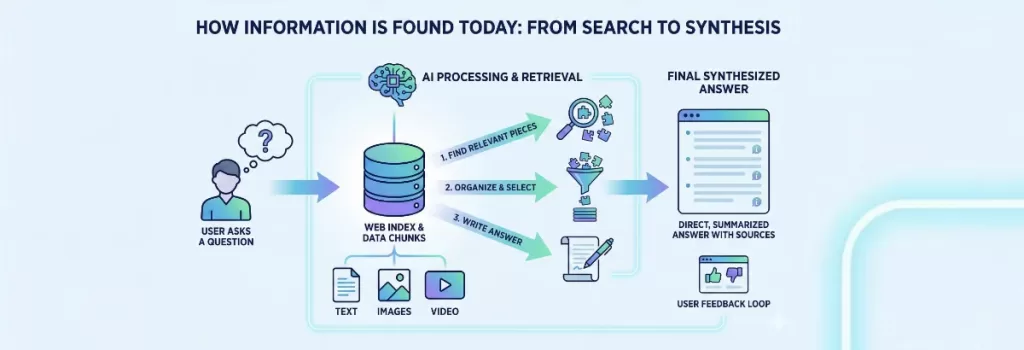
The primary technology behind this shift is known as data retrieval and generation. When you ask a question, the system follows three steps:
- Finding the pieces: The system searches the internet for chunks of text that match the meaning of your question.
- Organizing the pieces: It looks at which chunks come from the most trusted sources.
- Writing the answer: It combines those chunks into a paragraph that answers you directly.
For a business, this means you no longer want to just be a link on a page. You want to be the source of the specific chunk of information that the machine chooses to use.
Strategic Shift for Visibility
In the past, people focused on certain words to rank high. Now, the focus must be on being a trusted authority. If your website only repeats what everyone else says, the machine will summarize the general idea and never mention your name.
Focus on New Information
To be noticed, you must provide something the machine hasn't seen before. This is often called information gain. If you conduct a study and find that a specific industry trend is changing by 15 percent, that number is a unique fact. Because the machine wants to be accurate, it will use your 15 percent figure and likely name you as the source.
The Importance of Structure
Machines are efficient but literal. If you want a machine to understand your data, you must present it clearly. This involves:
- Direct Answers: Put the answer to a common question in the very first sentence under a heading.
- Clear Lists: Use bullet points for steps or features so the machine can easily copy them into a summary.
- Simple Labels: Clearly label your data, such as pricing, locations, and services, so there is no confusion.
The Role of Trust and Reputation
In this new world, your reputation across the whole internet matters more than the code on your website. Artificial intelligence learns about your brand by reading what other people say about you.

Mentions on Other Sites
If your company is discussed on news sites, industry forums, or review platforms, the machine begins to associate your brand with your specific field. This creates a web of trust. The machine thinks: Many trusted websites say this company is an expert in security, so I will recommend them when someone asks about security.
Community and Direct Connection
Because machines are now standing between you and your audience, it is vital to have a direct line to your customers. This is why newsletters and private groups are becoming more important. If a person is already on your email list, they don't need to use a search engine to find you. This protects your business from changes in how search engines work.
Adapting Your Content Style
The way we write must change. We are no longer writing for a person who is browsing; we are writing for a machine that is studying.
Moving Beyond Text
Search is becoming more than just reading words. Machines can now listen to audio and look at pictures.
- Video: If you make a video, you must provide a written version of everything said. The machine reads this transcript to understand the video content.
- Images: Every image needs a clear description in the background code so the machine knows what the picture represents.
Being a Primary Source
The goal is to be the person who created the data, not the person who talked about the data. If you are a curator, you are replaceable. If you are the creator of the original research, you are essential.
Key Facts
Human touch: People still value human perspectives. Use real stories and expert opinions that a machine cannot invent.
Google is not dead: It is integrating artificial intelligence into its own results.
Traffic will change: You might get fewer visitors, but the visitors you do get will be more interested in buying because they have already seen your information in an AI summary.
Quality over quantity: One deep, data-rich article is worth more than fifty short, generic blog posts.
If your business is creating content but still struggling to get discovered in search results, AI answers, or buyer research journeys, the issue is rarely the content itself. More often, it is a visibility and trust problem. If you would like a second opinion on your current content and discoverability strategy, book a call with us to explore where the gaps are and what can be improved.
Hootbox Media Works
Great Story Marketing for Great B2B SMEs
FAQs
1. Will AI search completely kill our website traffic and how do we measure success if clicks disappear?
It is highly likely that top-of-funnel informational traffic such as what is CRM will drop significantly as AI replaces Google search. Users will get these definitions directly in the interface. However, the traffic that does click through will be higher intent. You must shift your metrics from Volume to Velocity and Conversion Rate. Success in 2026 is measured by Share of Model, which is how often you are cited, and the quality of the leads, rather than raw distinct sessions. You may see 40% less traffic, but if your pipeline revenue remains stable, your strategy is working.
2. Should we block AI crawlers like GPTBot to protect our proprietary content?
This is a strategic trade-off. If your business model relies on selling data, such as a paid news site, you should block crawlers to prevent the AI from giving your product away for free. However, for most B2B service companies, the goal is visibility. Blocking crawlers means you voluntarily remove yourself from the world's largest discovery engine. When AI replaces Google search, being invisible to the AI is usually riskier than having your content summarized. Most B2B firms should allow crawling but optimize for citation.
3. How can we capture leads if the user never visits our website?
You must optimize for In-Platform Influence. Ensure your brand name is associated with the solution in the AI answer. Additionally, you need to rely more on Dark Social and brand advertising. If a user learns about you via ChatGPT but doesn't click, they might search for your brand directly later using a Navigational Search. You should also invest in Lead Magnets that cannot be consumed by AI such as interactive calculators, tools, or templates which compel the user to click through because the AI cannot replicate the utility.
4. Does email marketing work better or worse in an AI-first world?
Email marketing becomes significantly more valuable as AI replaces Google search. Because you cannot rely on SEO for consistent free traffic, your owned audience via your email list becomes your most critical asset. We are seeing a trend toward Plain Text and hyper-personalized B2B emails because they feel human. While AI search controls discovery, email controls retention. You should aggressively move any web visitor to your newsletter list to inoculate your business against search algorithm changes.
5. How do we get mentioned in ChatGPT or Perplexity answers without paying for ads?
You must optimize for Digital PR. AI models trust established, authoritative domains like major news outlets, university sites, and niche industry forums. If you get covered by Forbes or a leading industry trade journal, the AI reads that coverage and associates your brand with the topic. Unlike traditional SEO, where you wanted a link, here you want the semantic association. Being discussed in Reddit threads with positive sentiment is also a powerful signal, as AI models weigh Reddit data heavily for human perspective.
6. Is long-form content dead if AI just summarizes it?
No, fluff content is dead. Long-form content is actually vital, but it must be High Density. If you write 3,000 words of generic advice, AI replaces Google search by summarizing it in one paragraph. But if you write 3,000 words containing original datasets, contrarian arguments, and deeply technical nuance, the AI is forced to cite you because it cannot hallucinate that specific data. Deep, expert content is the feedstock for AI; without it, you cannot be a primary source.
7. How do we optimize our video content for AI search?
AI models use Multi-Modal processing, meaning they can analyze video and audio. To optimize, you must provide high-quality transcripts and detailed descriptions for every YouTube or Vimeo upload. You should also break videos into clearly defined chapters with descriptive titles. This allows the AI to watch your video and pull a specific segment to answer a user's question. As AI replaces Google search, video becomes a searchable text database.
8. What is Schema Markup and why is it urgent now?
Schema markup is code that helps machines understand what your data is. As AI replaces Google search, LLMs rely on this structured data to avoid hallucinations. If you want the AI to accurately display your pricing, ratings, or product specs in a comparison table, you must use Schema. It is the common language between your website and the AI. Without it, the AI has to guess your data, which often leads to exclusion.
9. Will buying ads on AI search engines be necessary?
Likely, yes. As organic real estate shrinks, platforms like Perplexity and ChatGPT are introducing Sponsored Answers or Suggested Follow-ups. Just as B2B companies had to move from organic social to paid social, you will likely need to allocate budget to Sponsored Citations. This guarantees your brand appears in the consideration set when a user asks a high-intent commercial question. When AI replaces Google search, the ad model shifts from Pay per Click to potentially Pay per Suggestion.
10. Can we use AI to write our content if we want to rank in AI search?
You can use AI for research and outlining, but relying on it for drafting is dangerous. AI models are trained on existing internet data. If you use AI to write your content, you are creating a copy of a copy. This creates a Model Collapse effect where your content is generic and indistinguishable. To rank when AI replaces Google search, you need Information Gain—new information that the AI does not yet know. Only humans or AI fed with proprietary primary data can create the unique insights that AI search engines prioritize.