
In the current enterprise market, CHROs are no longer seeking training vendors; they are seeking strategic partners for talent survival. This comprehensive guide outlines the necessary pivot for L&D professionals to remain relevant. It details how to optimize a profile for problem-solving, leverage algorithm mechanics like dwell time, and implement a content strategy that builds authority. This playbook on LinkedIn for learning and development companies provides the roadmap to securing high-ticket enterprise contracts.
The Limitations of Promotional Content
When searching for a corporate training company CEO on social media, the feed often resembles a stream of digital brochures. These posts typically consist of announcements regarding new modules, partnership updates, or requests to download a prospectus. While this approach is common, it is often ineffective because it treats the platform as a simple noticeboard for company news.
In the current market, Chief Human Resources Officers (CHROs) and L&D Heads are not seeking more content; they are seeking solutions to organizational challenges. They face issues such as AI displacing roles, rising attrition, and leadership gaps. Therefore, the strategy regarding LinkedIn for founders of Learning and Development agencies must shift from promoting course catalogs to proving strategic value. The goal is to transition from being a vendor of training hours to a partner in talent transformation. This guide outlines how to restructure a presence on LinkedIn for founders of Learning to attract high-ticket enterprise contracts.
Phase 1: Optimizing the Profile for Problem Solving
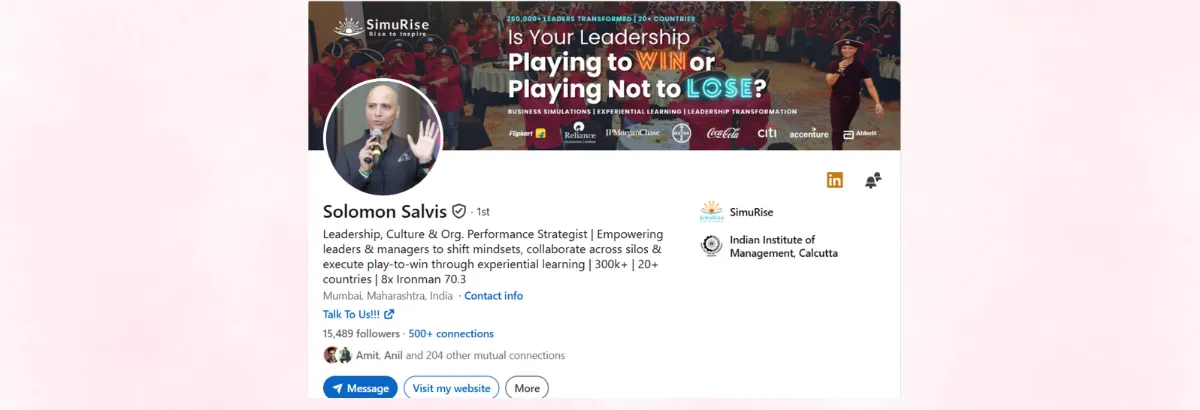
A professional profile should function less like a resume and more like a landing page. When a decision-maker views a profile, they are assessing whether this individual can solve a specific organizational crisis.
1. Creating an Outcome-Focused Headline Most profiles fail to convert because they focus on titles rather than business outcomes. A headline that simply states "Founder & CEO | Corporate Trainer" categorizes the individual with thousands of other providers. LinkedIn for founders of Learning and Development firms requires a headline that identifies the target audience, the specific problem, and the measurable result.
- Effective Example: "Helping CHROs in Manufacturing Reduce Attrition by 20% through Frontline Leadership Frameworks."
2. Utilizing the Featured Section Instead of displaying generic awards, this section should showcase Intellectual Property (IP). An effective approach to LinkedIn for founders of Learning and Development involves curating three specific assets:
- A Direct-to-Camera Video: An explanation of why standard L&D models are failing in the current economy.
- A Diagnostic Tool: A downloadable PDF resource, such as a "Skills Gap Audit," which adds immediate value.
- A Case Study: A detailed breakdown of how a specific client saved money or improved retention through the firm's intervention.
3. The Visual Banner (Prime Real Estate) The background banner is often wasted space. It should not merely display a company logo. Instead, it should visually reinforce the value proposition. A strong banner on LinkedIn for founders of Learning and Development agencies includes a clear statement of the methodology (e.g., "The 4-Step Adaptive Learning Framework") and social proof, such as logos of enterprise clients served.
Phase 2: Developing a Strategic Content Narrative
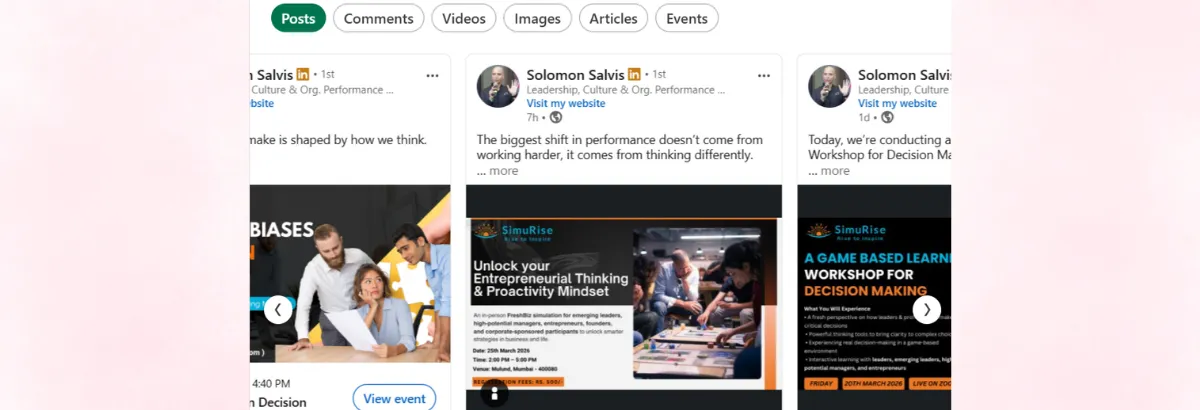
To effectively use LinkedIn for founders of Learning and Development companies, the founders’ profile requires moving beyond neutral updates to opinionated, data-backed insights. There are four content pillars that help build authority.
Pillar 1: Addressing Market Urgency L&D is often viewed as discretionary spending. To change this, content must highlight market crises that training can solve. To leverage LinkedIn for founders of Learning and Development companies, we need to build urgency.
- Concept: A post explaining how AI agents are replacing reporting tasks, and why managers without strategic skills will become liabilities. This creates a compelling reason for the CHRO to act.
Pillar 2: Prioritizing Outcomes Over Compliance Many corporate training programs are driven by compliance requirements rather than actual skill acquisition.
- Concept: A strategic post might argue that completion certificates are vanity metrics. By advocating for learning in the flow of work rather than multi-day workshops, the founder signals a commitment to actual business results.
Pillar 3: Demonstrating Methodology Openly Many training companies hide their curriculum. However, a strong strategy regarding LinkedIn for founders of Learning and Development companies focuses on transparency.
- Concept: Sharing the exact syllabus of a program proves competence. It demonstrates that the value lies in the delivery and implementation, not just the information itself.
Pillar 4: Showcasing Learner Transformation Instead of just posting a client logo, it is more effective to tell the story of a specific employee's transformation.
- Concept: Using LinkedIn for founders of Learning and Development companies effectively means sharing detailed narratives of how specific employees improved performance or retention through coaching, providing tangible proof of impact.
Phase 3: Leveraging Algorithm Mechanics
To maximize reach, founders must understand how the platform distributes content. The algorithm favors "Dwell Time", the amount of time a user spends consuming a specific post.
The Power of Carousel Documents For L&D founders, the most effective format is often the PDF Document (Carousel). This format allows the founder to break down complex frameworks into swipeable slides.
- Why it works: Users spend significant time swiping through 10-12 slides, which signals high relevance to the algorithm. A core tactic of LinkedIn for founders of Learning and Development companies is translating training slides into high-value social carousels.
Avoiding External Links The platform penalizes posts that link users to external websites (like a blog or YouTube). To maintain visibility, the link should be placed in the comments section or the "Link in Bio" feature. Keeping the user on the platform is essential for maximizing reach on LinkedIn.
Phase 4: Building Relationships Through Value

Cold pitching decision-makers is rarely effective, as they receive numerous sales messages daily. In the context of LinkedIn for founders of Learning and Development companies, a value-first approach yields better results.
The Expert Interview Approach Instead of asking for a sales meeting, the founder can invite the target CHRO to share their expertise.
- The Approach: "Hosting a discussion on 'New Talent Models.' Would you be open to sharing your views on diversity hiring?" This appeals to their status as thought leaders. Once the relationship is established through the discussion, transitioning to a business conversation about their specific pain points becomes natural.
The Strategic Commenting Strategy Posting content is only half the battle. Engaging with other thought leaders is equally important.
- The Strategy: Instead of writing generic comments like "Great post," founders should write "Mini-Articles" in the comments section. By adding a substantial paragraph that expands on the original post with a unique perspective, the founder borrows the authority of the original poster and increases profile visibility.
Phase 5: A Structured Weekly Execution Plan
Maximizing the potential of LinkedIn for founders of Learning requires consistency. A structured weekly routine ensures visibility without causing operational burnout.
- Monday (The Provocation): Post a data-backed opinion on a current talent crisis (e.g., "Why the MBA is losing value").
- Tuesday (The Outreach): Send invitations to key decision-makers to be interviewed or quoted in an upcoming article.
- Wednesday (The Education): Share a PDF carousel detailing a specific training framework or methodology.
- Thursday (The Engagement): Spend 20 minutes engaging with the content of other HR influencers to build network visibility.
- Friday (The Proof): Share a specific success story of a student or client transformation.
Transitioning from Vendor to Strategic Partner
The L&D market is crowded with providers selling generic content. However, there is a shortage of strategic partners who can articulate a clear vision for talent survival.
By utilizing the full potential of LinkedIn for Learning and Development, founders can position themselves as authorities on the future of work. This shift allows them to stop competing on daily training rates and start competing on the strategic value they deliver to the organization. When the profile, content, and engagement strategy align, the founder ceases to be a salesperson and becomes a trusted advisor in the eyes of the enterprise buyer.
Hootbox Media Works
Great Story Marketing for Great B2B SMEs
FAQs
1. Should an L&D founder invest time in a LinkedIn Newsletter or stick to regular posts?
A LinkedIn Newsletter is distinct from a regular post because it triggers a notification to every subscriber’s inbox, ensuring higher visibility. For experts utilizing LinkedIn for founders of Learning, a newsletter is a strategic asset. While regular posts are ephemeral (disappearing from feeds within 24-48 hours), a newsletter builds a permanent library of thought leadership. It is particularly effective for L&D founders because it allows for "Deep Work" content like long-form analysis of talent trends which establishes the depth of expertise required to sell high-ticket training contracts.
2. What is the role of the "Company Page" versus the "Founder’s Personal Profile"?
Data consistently shows that personal profiles generate 10x more engagement than company pages in the B2B sector. Humans prefer to interact with other humans, not logos. However, the Company Page serves a critical "Validation" role. When a CHRO visits a founder's profile, they will often click on the company link to check legitimacy (e.g., employee count, website link). The strategy for LinkedIn for founders of Learning should be: use the Personal Profile for growth, networking, and opinion, and use the Company Page as a repository for official updates, culture photos, and employee advocacy.
3. Is LinkedIn Sales Navigator necessary for selling corporate training services?
For L&D founders targeting enterprise clients, LinkedIn Sales Navigator is an essential investment, not an optional tool. The free version of LinkedIn restricts search capabilities, making it difficult to filter for specific decision-makers like "CHROs in Manufacturing companies with 1,000+ employees in Mumbai." Sales Navigator allows founders to build highly targeted lead lists, track job changes (e.g., when a target prospect moves to a new company), and send InMails to decision-makers outside their network. It transforms LinkedIn for founders of Learning from a passive marketing channel into an active sales pipeline.
4. How can L&D founders use LinkedIn Audio Events compared to Video Lives?
LinkedIn Audio Events are an underutilized tool that lowers the barrier to entry for networking. Unlike video livestreams, which require lighting, cameras, and appearance readiness, Audio Events are "radio-style" rooms. This format is excellent for L&D founders because it encourages "Town Hall" style discussions. A founder can host a 20-minute discussion on "The Future of Hybrid Work," invite CHROs to the "stage" to speak, and build relationships without the pressure of being on camera. It creates an intimate, low-friction environment for demonstrating authority.
5. How should a founder handle negative comments or public disagreements on their Intellectual Property?
In the L&D space, sharing strong opinions (e.g., "The 70-20-10 model is dead") often invites debate. Founders should view disagreement not as a PR crisis, but as an algorithm booster. When a user disagrees respectfully, the founder should engage deeply, treating the comment section as a public debate stage. This signals confidence in their methodology. If the comment is a "troll" or abusive, ignoring it is best. However, a professional debate on methodology often increases respect from silent observers (potential buyers) who value a founder who can defend their thesis.
6. How can an L&D founder transition a LinkedIn follower onto an Email List?
LinkedIn is "rented land." Algorithm changes can reduce reach overnight. Therefore, a critical objective of LinkedIn for founders of Learning is to move high-value followers to an "owned" email list. The most effective method is the "Resource Bridge." Instead of asking people to "Sign up for my newsletter," the founder should offer a specific, high-utility asset (e.g., "The 2026 Leadership Competency Map") in exchange for an email address. This link can be placed in the "Featured" section or the "Link in Bio," ensuring that the audience is captured in a database that the founder controls.
7. Can AI tools be used to write LinkedIn posts for L&D thought leadership?
While AI tools like ChatGPT can assist with formatting and ideation, relying on them for core content is dangerous for L&D founders. Corporate training is a business of "Human Transformation." If a founder's content feels robotic, generic, or lacks personal nuance, it undermines the very premise of their service. The best practice is to use AI for structure (e.g., "Summarize this article into bullet points") but to ensure the insight, opinion, and tone remain authentically human. The audience buys the founder's unique perspective, not a generic summary of industry trends.
8. What is the "Social Selling Index" (SSI) and does it matter for L&D founders?
The Social Selling Index (SSI) is a score from 0-100 given by LinkedIn that measures a user's effectiveness at establishing a professional brand, finding the right people, engaging with insights, and building relationships. For founders, a score above 70 is generally considered strong. While the score itself is a vanity metric, the components are useful diagnostics. If an L&D founder has a low SSI, it usually indicates they are either not connecting with enough decision-makers (CHROs) or not engaging enough with other people's content. It serves as a health check for their LinkedIn for founders of Learning strategy.
9. Does high production value correlate with higher sales?
Should L&D companies use LinkedIn Ads or focus solely on Organic Content?
LinkedIn Ads are notoriously expensive, with high Cost-Per-Clicks (CPC). For L&D founders, organic content is usually superior for building trust because high-ticket training contracts are rarely sold via a direct "Click to Buy" ad. However, Ads can be effective for Retargeting. If a CHRO visits the founder's website but doesn't inquire, a LinkedIn Ad showing a client case study can keep the brand top-of-mind. The strategy should be: Organic for trust and reach; Ads for retargeting warm leads who already know the brand.
10. How can founders mobilize their team (trainers/consultants) for Employee Advocacy?
A founder's reach is limited, but the collective reach of their trainers and consultants is exponential. Employee Advocacy involves encouraging the team to post about their work. However, forced sharing of company posts rarely works. Instead, the founder should encourage trainers to share "Field Notes", stories from the workshops they deliver (without naming clients confidentially). When a trainer posts about a breakthrough moment in a leadership session, it validates the company's quality. This decentralizes the brand and provides multiple entry points for potential clients to discover the firm.