
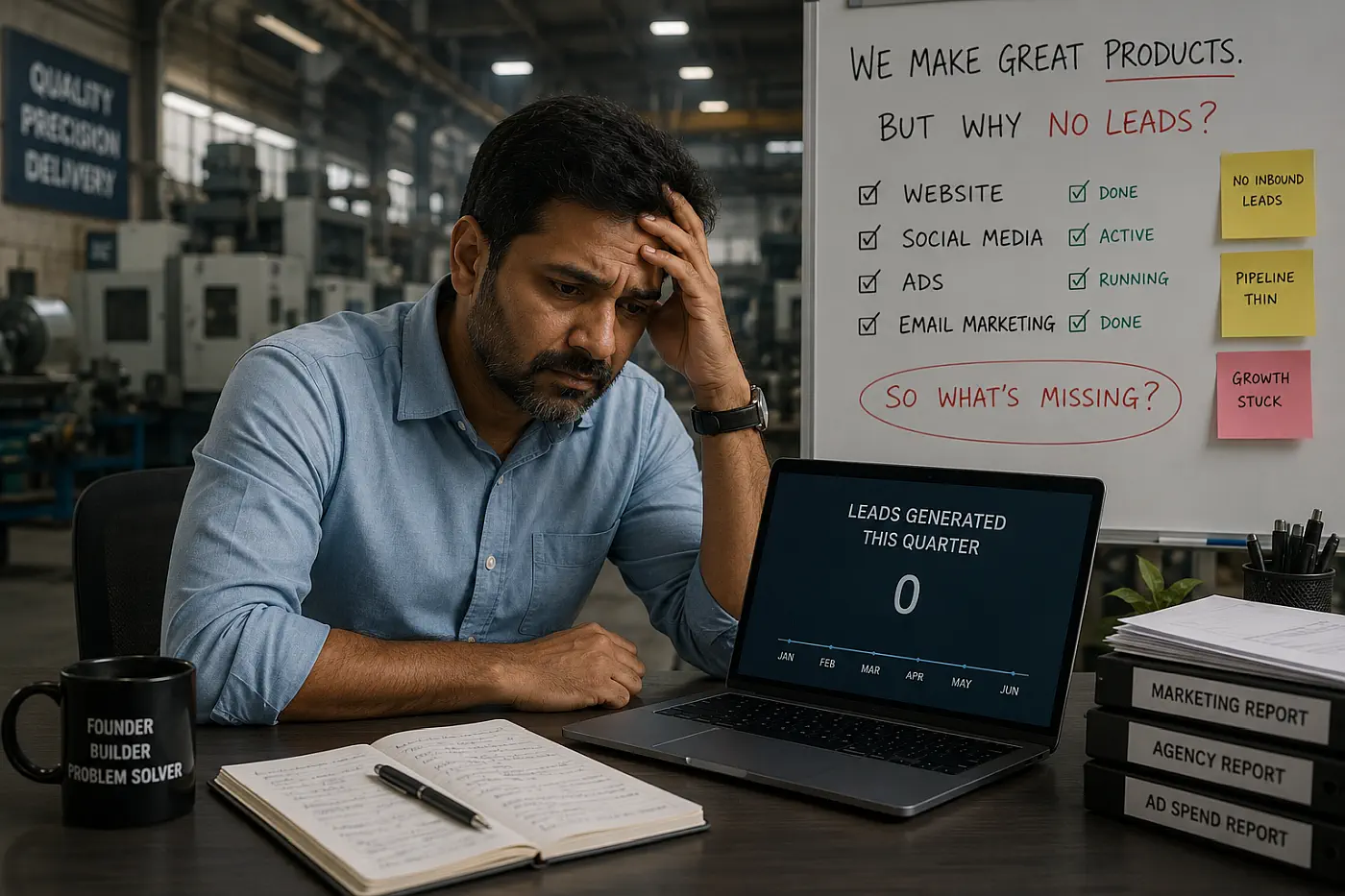
Why isn’t B2B marketing generating leads?
In most cases, it’s not a marketing problem – it’s a business strategy problem rooted in an unclear ideal customer profile (ICP), a poorly defined offer, and messaging that doesn’t speak to a specific buyer.
What is the root cause of poor B2B lead generation?
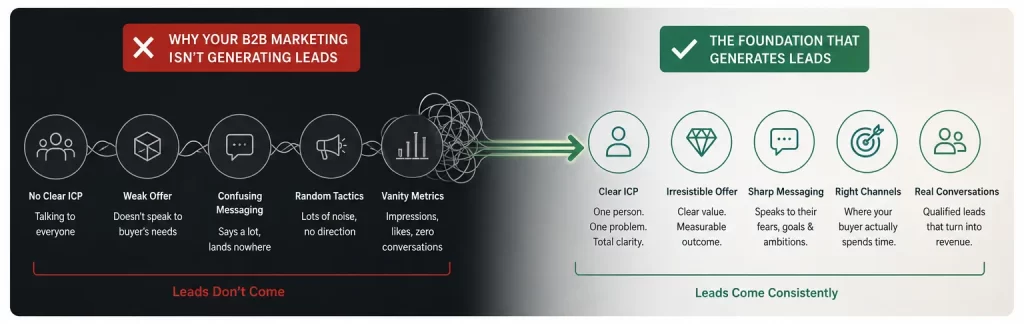
The most common root cause is targeting “everyone” instead of a specific ICP. Without a defined ideal customer, the offer can’t be shaped to their needs, and messaging fails to land. Three things break in sequence: ICP → offer → messaging.
Why do B2B marketing agencies fail to fix lead generation?
Most agencies skip foundational questions like – what the client actually buys, what success looks like, and what proof exists of results. They start producing content immediately and measure success by reach and impressions, not qualified conversations.
What metrics should B2B founders track instead of likes and comments?
The metric that matters is real conversations started, not engagement. B2B buyers research quietly for months before reaching out. Vanity metrics like likes often reflect an audience that was never going to buy.
What are the first steps to fix B2B marketing that isn’t generating leads?
1) Define a specific ICP (one person, one company type, one problem). 2) Pressure-test the offer so it describes outcomes for the buyer, not features. 3) Rewrite messaging until prospects feel directly addressed. 4) Find where your buyer actually spends time. 5) Show up and serve your audeince consistently. Don’t chase virality.
Every B2B founder I’ve spoken to has asked some version of this question. Some ask it after spending three lakhs on a website that sits quietly collecting nothing. Some ask it after six months with an agency that delivered reports full of impressions and zero conversations. Some ask it at lunch on a slow Tuesday, pipeline thin, two proposals gone cold.
The question feels like a marketing question. It isn’t.
It’s almost always a strategy question. And the strategy problem starts somewhere most founders don’t think to look.
We break down the fixes in our guide to the top marketing strategies for B2B SMEs.
The Real Reason Your Marketing Isn’t Working
When a founder tells me their marketing isn’t generating leads, my first question isn’t about their content calendar or their LinkedIn strategy or their ad spend. I ask: who are you going after, exactly?
Nine times out of ten, the answer is some version of “companies that need what we offer.” Which is another way of saying everyone. Which is another way of saying no one.
That’s where the diagnosis usually starts. But it rarely stops there. In almost every case we’ve seen, three things are broken at once: the ICP, the offer, and the messaging. And they’re broken in that order, because each one depends on the one before it.
Without a clear ideal customer profile, you don’t know who you’re talking to. Without knowing that, you can’t shape an offer that speaks to what they actually want. And without a sharp offer, your messaging has nothing to carry. It ends up saying a lot and landing nowhere.
The result is a prospect who reads your website, scans your LinkedIn, and still can’t tell if you’re talking to them. They don’t know whether you understand their fears or their ambitions. They have no idea how you’d actually help. So they leave. And your marketing keeps running, generating noise instead of leads.
What this looks like in practice
We worked with an L&D company selling high-ticket, in-person, game-based learning experiences. They have a good product, robust delivery and stellar real-world results for clients. But their marketing was going in every direction, speaking to everyone from HR heads to operations leads to C-suite at companies of every size. Their website said a lot of things and convinced nobody.
When we sat down with them, the problem wasn’t their content. They hadn’t decided who they were for, which meant they hadn’t shaped an offer that spoke to anyone in particular, which meant their messaging was all over the place. Once we fixed the ICP, the offer sharpened. Once the offer sharpened, the messaging finally had something to say. We rebuilt their website around the story of their client as the hero, set up a LinkedIn strategy that started real conversations, and the results followed. They went from zero inbound leads to 22 leads in six months from their website alone. LinkedIn continued to compound from there.
The ICP was treated like the foundation everything else stood on.
Why Past Agencies and Freelancers Didn’t Fix This
Most founders who come to us have tried something before. A freelancer who was great with Canva or an agency with an impressive deck or even a course from someone big on LinkedIn. Some of it worked briefly but none of them mattered long term.
The reason is usually the same. There’s no shared clarity between the founder and whoever is doing the marketing. The agency doesn’t ask about the business model. They don’t ask about customer acquisition cost or lifetime value. They don’t ask what the offer actually is or what proof exists that it delivers. They start producing content without any of this in place, and then they measure success by reach and engagement.
This creates a particular kind of frustration. The founder feels betrayed. The agency feels misunderstood. Neither is entirely wrong. What’s missing is a common definition of what winning looks like.
The Questions Most Agencies Never Ask
At Hootbox Media Works, before we produce a single piece of content, we work through a set of questions that most agencies skip entirely.
- What does your client actually buy, and what problem does it solve for them?
- What does success look like in specific, measurable terms?
- What would make this engagement a clear win for your business?
- What proof do you have that you can deliver the results you’re promising?
- What is your offer, and does it describe what’s in it for the buyer?
- Explain your Unique Value Proposition. Why should your prospect care?
These questions feel slow. They aren’t. They’re the difference between marketing that compounds and marketing that resets every three months.
The Vanity Metrics Trap
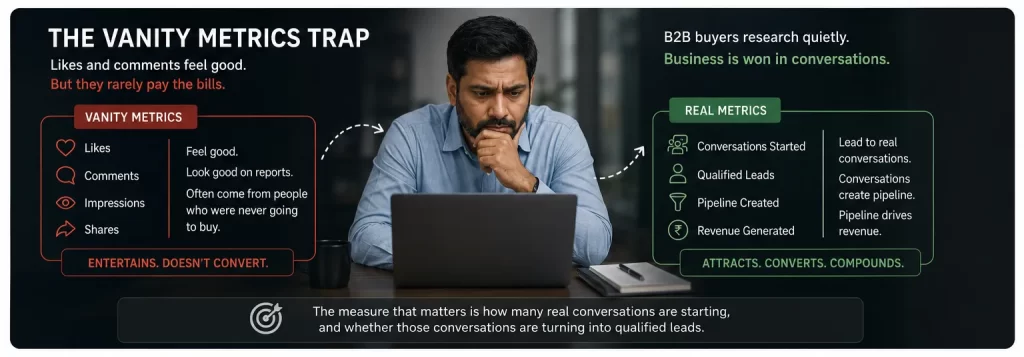
Here’s something that took some of our clients a while to accept. Their ideal buyers are not liking their posts. They’re not commenting. Most of them aren’t engaging publicly at all.
But they’re watching.
B2B buyers in India, whether they’re heading an L&D function, running a manufacturing unit, or building out a consulting practice, do their research quietly. They read your posts for months before they reach out. They visit your website, then check your LinkedIn profile, then Google your name, then ask a peer if they’ve heard of you. By the time they message you, they’ve already half-decided.
This is what makes vanity metrics so dangerous. Likes and comments feel like proof that something is working. Often they’re proof that you’re entertaining people who were never going to buy. The measure that matters is how many real conversations are starting, and whether those conversations are turning into qualified leads.
This makes a strong LinkedIn strategy is no longer optional for B2B founders who want to build trust before the first conversation.
The B2B Buyer Doesn’t Move on Your Timeline
One of the most important things I’ve learned from working with B2B businesses across industries is that the customer journey is not linear and it’s not fast. A prospective client might find you on LinkedIn, check your website three weeks later, ask AI about your category six months after that, have an internal conversation about it at the end of the year, and then reach out when their budget finally opens up.
You don’t get to control when they’re ready. You only get to control whether you’re there when they are.
This is why consistency matters more than brilliance. A founder who shows up with genuinely helpful content week after week, who answers the questions their prospects are asking before anyone ever calls them, who builds a body of work that shows they understand this problem better than anyone, that founder is the one who gets the call when the timing is right.
Your content should make the buyer the hero
Here’s a frame that changed how we approach content for every Hootbox client. The prospect is the hero of the story. Their problem is the obstacle. You’re the guide who knows how to help them past it. The moment your content starts talking about how great you are instead of how well you understand them, you’ve lost the plot.
This shows up everywhere. In how you write your website. In how you structure a LinkedIn post. In how you describe what you do when someone asks. If the buyer can’t see themselves in your story, they won’t see a reason to talk to you.
What to Do First
If you’re reading this and recognising your business in any of this, here’s where to start.
Step 1: Get your ideal customer profile right
Not a demographic sketch. A real, specific picture of one person at one kind of company in one industry with one problem. Name their fears. Name their aspirations. Name the things they believe that are keeping them stuck. This is the work that makes everything else possible.
Step 2: Pressure-test your offer
What you’re selling needs to be described in terms of what it does for the buyer, not what it is. If you can’t say in one sentence what your client gets from working with you, that’s your next problem to solve. The offer has to answer the question your prospect is already asking: what’s in it for me?
Step 3: Fix the messaging
Once the ICP is clear and the offer is sharp, look at every piece of content you’ve put out. Does it speak directly to that person? Does it show you understand their fears, their goals, the gaps they’re quietly trying to close? If a prospect reads your website and still isn’t sure you’re talking to them, your messaging hasn’t done its job. Rewrite until they feel seen.
Step 4: Find out where your buyer actually spends time
LinkedIn is usually part of the answer for B2B. So is word of mouth from trusted peers. So is showing up in Google, Youtube and AI search when someone types in a question your prospect is asking when he really needs it.
Step 5: Be consistent
Not viral. Not clever. Consistent. Show up with something genuinely useful, week after week, until the right person at the right moment recognises themselves in what you’re saying and reaches out.
Bonus: Document everything
This is the step most founders skip. Your failures, your client wins, the conversations that changed how you see your market, the question a client asked that made you rethink your whole approach. These stories are your best content. They’re also proof that you know what you’re doing, which is exactly what a B2B buyer needs to see before they trust you with their business.
Not sure whether your marketing foundation is actually solid? The free Authority Snapshot at swiy.co/aiaudit will show you exactly where the gaps are before you spend another rupee on content, ads, or agencies.
And if your buyers are checking your LinkedIn profile before reaching out, explore our LinkedIn Marketing Services for B2B SME founders to build authority, trust, and qualified conversations consistently.