
The era of high-volume, automated lead generation is ending. As AI saturates the market with generic content and templated outreach, B2B buyers have developed a high sensitivity to artificial sales tactics.
This comprehensive guide details a new operating model for LinkedIn revenue growth – Hootbox Media Works’ LinkedIn Trust Builder that focuses on how to make linkedin work for your business. We dismantle the outdated tactics of persuasion and replace them with the mechanics of credibility. You will learn how to transform your profile into a conversion asset, implement the Recursive Insight Engine for content, and execute the Diagnostic Dialogue framework to close deals without friction.
The Old B2B Sales Playbook Has Broken
The digital sales environment is experiencing a fundamental structural shift. For the last ten years, the standard playbook for B2B growth relied on volume. Sales teams measured success by the number of connection requests sent, the volume of cold messages distributed, cold calling, and the frequency of content posted. This industrial approach to lead generation assumes that humans are mere data points to be pushed through a linear conversion funnel.

This model is failing.
Buyers today possess extremely high sensitivity to automation and manipulation. They recognize templated outreach immediately and instinctively ignore it. The strategies that worked five years ago now damage brand reputation rather than building it. When every competitor uses the same AI-generated scripts and the same urgency triggers, the market becomes deaf to the noise.
To understand how to make LinkedIn work for your business in the current economy, you must abandon the extraction mindset. You must adopt a cultivation mindset. Success no longer comes from shouting the loudest or automating the fastest. It comes from building the highest density of trust.
This playbook outlines a comprehensive, end-to-end system to replace high-friction sales tactics with a reliable engine that generates revenue through authority, consistency, and deep psychological alignment.
Part 1: What Are the New Mechanics of Commercial Trust?
Trust is not an abstract feeling or a soft skill. It is a predictable mechanism that governs commercial interactions. It follows specific laws that can be observed, measured, and optimized. When a buyer chooses to engage with a vendor, they are unconsciously calculating a specific formula. Understanding this formula is the first step in learning how to make LinkedIn work for your business.
The LinkedIn Trust Builder Credibility Formula
We have experienced that prospect evaluates three distinct variables before booking a call or signing a contract.
- Probability of Outcome: How likely is it that you can deliver the promised result?
- Perceived Value: The utility they expect to receive from the engagement.
- Perceived Risk: The cost of engagement, which includes financial investment, time commitment, and reputational exposure.
Most businesses attempt to increase sales by hyping the value. They make bigger promises and use louder marketing. However, the most effective lever for growth is actually reducing the risk. Every time a business uses false urgency, aggressive follow-up tactics, or vague promises, the perceived risk spikes, and the credibility formula collapses.
To solve this, your LinkedIn strategy must focus entirely on risk reduction. You achieve this by proving competence before asking for the sale.
The Six Psychological Thresholds of Buyers

Buyers do not jump from being strangers to being clients in one step. They move through six distinct psychological thresholds. You cannot force a prospect through these gates; you can only guide them.
Threshold 1: Validity The prospect assesses if you are a real expert or a marketing fabrication. They look at your profile, your consistency, and the depth of your content. If you fail here, you are dismissed as a spammer.
Threshold 2: Relevance The prospect determines if your solution applies to their specific identity and industry. They ask if this is for people like them. If your messaging is too broad, they disconnect.
Threshold 3: Understanding The prospect tests if you grasp the nuance of their specific problem. They look for specific language that mirrors their internal monologue. General observations fail here; specific symptoms win.
Threshold 4: Safety The prospect calculates the risk of engagement. They wonder if replying to your message will lead to a high-pressure pitch. They wonder if your solution will disrupt their current workflow.
Threshold 5: Effort The prospect evaluates the difficulty of implementation. Even if they trust you, they may not buy if the process seems too difficult. You must demonstrate a low-friction path to value.
Threshold 6: Projection The prospect visualizes themselves achieving the result with your help. This is the final identity shift where they see themselves as your client.
Your content and messaging must address these thresholds sequentially. Attempting to close a deal before a prospect has crossed the Safety threshold results in ghosting and lost revenue.
Part 2: How Do I Transform My LinkedIn Profile Into a Conversion Asset?
Before executing any outreach, you must build the foundation. Your digital presence must act as a filter that attracts ideal clients and repels poor fits. If your infrastructure is weak, all subsequent traffic generation efforts will be wasted.
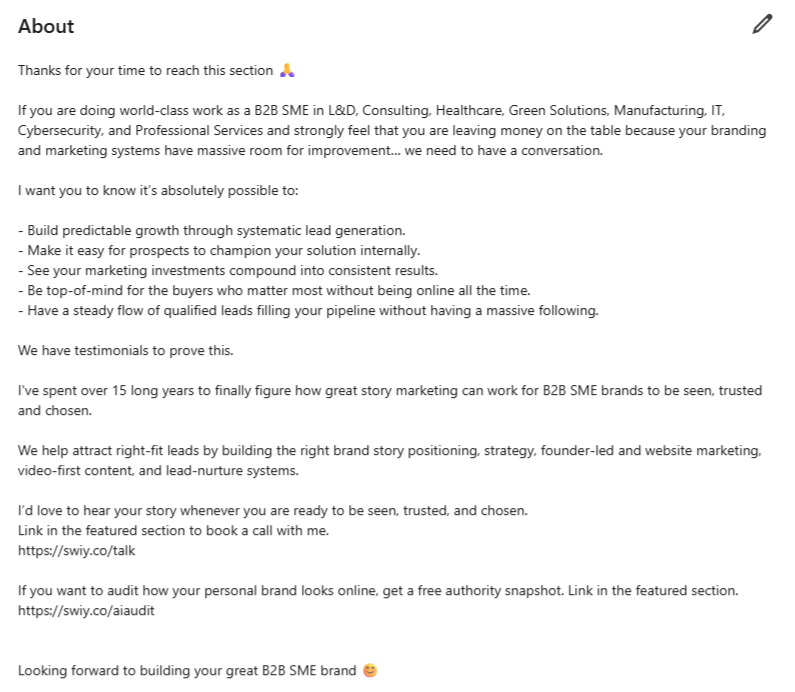
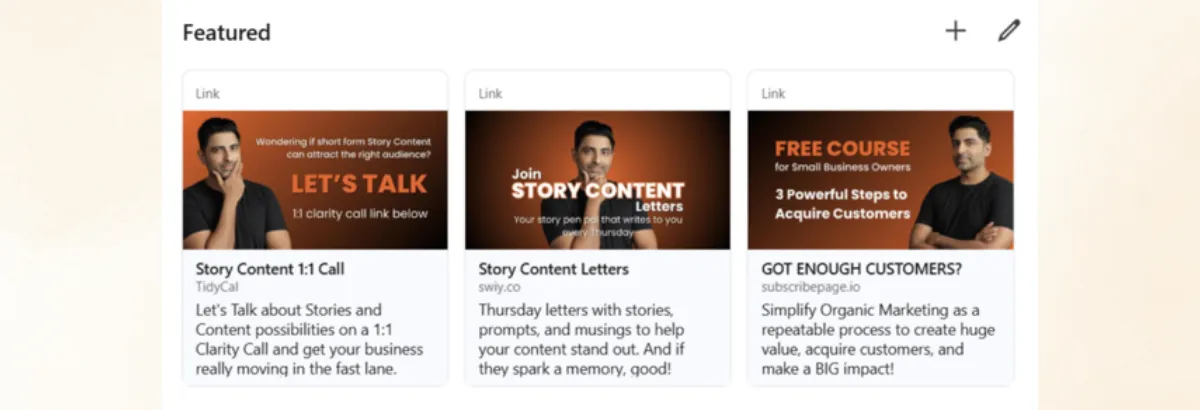
We have used the LinkedIn profile of Hootbox Media Works Founder, Amit Suvarna. You can take a look at the profile here for a quick view of what all goes into building a strategic LinkedIn profile.
The Headline Strategy
The majority of professionals treat their LinkedIn profile as a resume. This is a fundamental error. A resume looks backward at what you have done. A sales asset looks forward at what you can do for the client.
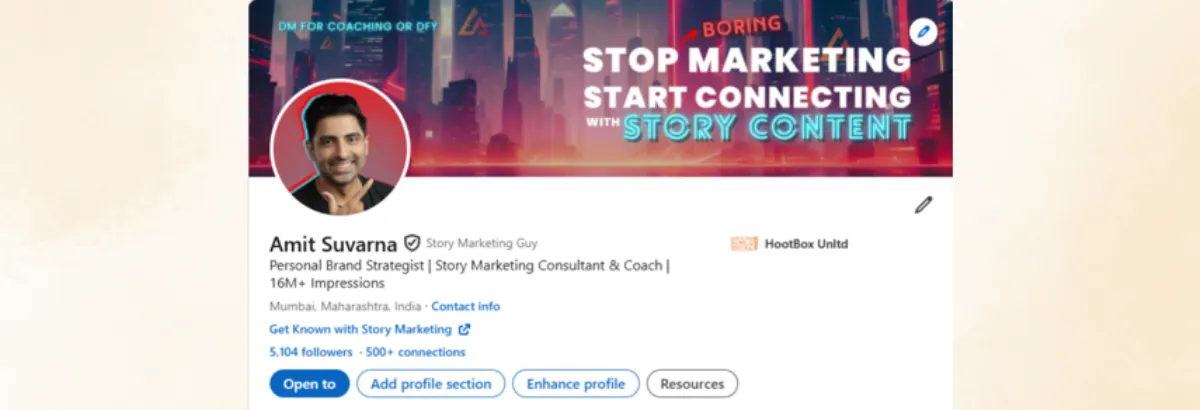
Remove generic titles like Founder or CEO. These tell the prospect nothing about the value you provide. Replace them with a clear value proposition statement. It should define the target audience and the specific outcome provided.
- Weak Headline: Founder of Apex Logistics Solutions.
- Strong Headline: Helping Manufacturing CIOs reduce downtime by 18% through predictive analytics.
Implementation Step: Draft three variations of your headline focusing on the outcome. Ask yourself: “If my ideal client only read this one line, would they know exactly what I do?”
The Banner Strategy
The banner image is the most valuable real estate on your profile. Do not use abstract geometric shapes or city skylines. Use this space to reinforce your authority. It should include a clear statement of what you do and a form of social proof, such as logos of companies you have worked with or a specific result you have achieved.

The About Section Strategy
This section should function as a manifesto. Do not list your awards or your history. Instead, use this space to articulate the current state of the industry. Explain why the standard solutions are broken. Introduce your unique methodology as the logical alternative.
Structure for a High-Converting About Section:
- The Hook: Identify the expensive problem the reader is facing immediately.
- The Agitation: Explain the cost of ignoring this problem. Why is it dangerous to wait?
- The Failure of Status Quo: Explain why traditional methods fail to solve it.
- The New Mechanism: Introduce your proprietary mechanism or framework.
- The Call to Action: Provide a low-friction step, such as reading your Protocol Document.
The Featured Section Strategy
This is your portfolio of proof. Do not link to your website home page. Link to high-value assets that allow the prospect to binge-consume your expertise. This should include your Protocol Document, a high-performing case study, and perhaps a video interview where you demonstrate your knowledge.
Part 3: What Is a Marketing Protocol Document and Why Do I Need One for Sales?
Standard sales advice suggests getting a prospect on a call to explain your services. On LinkedIn, this pitch-slap approach creates immediate friction; a prospect scrolling their feed isn’t ready for a 30-minute commitment. A superior method is to create a Marketing Protocol Document.
This is a comprehensive asset, roughly ten to fifteen pages in length, that acts as your “Asynchronous Salesperson.” By pinning this to your LinkedIn Featured Section or offering it in this DMs, you provide a low-friction “next step” that allows prospects to binge-consume your expertise without the fear of being sold to. It serves as a belief artifact that does the selling for you before you ever hop on Zoom.
This is what you need to include in the Marketing Protocol Document –
Component 1: The Diagnosis
Start by describing the prospect’s situation better than they can describe it themselves. When you accurately articulate a problem, the prospect automatically credits you with the solution. Avoid generalities. Use specific technical language that proves you understand their daily reality.
Component 2: The Mechanism
Explain exactly how you deliver results. Do not use vague terms like consulting or optimization. Use specific names for your processes. For example, instead of saying you fix email marketing, say you implement the Recursive Email Triangulation method. Naming your process makes it tangible and valuable. It turns a service into a product.
Component 3: The Logistics
Be radically transparent about how the engagement works. Detail the onboarding process step-by-step. Explain the communication cadence. List exactly what is required from their team. This reduces the “Effort” threshold mentioned earlier.
Component 4: The Investment
Include your pricing. Many sales trainers advise against this, arguing you should hide price until the call. However, revealing price upfront filters out unqualified leads and builds massive trust with qualified ones. It shows you are confident in your value and respects the buyer’s time.
Why this works: Providing this document upfront demonstrates radical transparency. It answers technical questions and pricing concerns before a meeting occurs. This dramatically lowers the perceived risk for the buyer. When a prospect reads the Protocol Document and still books a call, they are already educated and pre-sold on your approach.
Part 4: How Do I Build a Content Engine on LinkedIn That Generates Trust?
Content marketing often fails because it becomes performative. Creators write what they think the algorithm wants rather than what is true. To learn how to make LinkedIn work for your business, you must shift from creating content to documenting insights.
The Audio Extraction Workflow
Perfectionism causes writer’s block. To bypass this, change the input mechanism from typing to speaking.
- Record: Spend ten minutes daily recording a voice note while walking or driving. Speak about a specific client problem solved that day, a pattern noticed in the market, or a misconception held by a prospect.
- Transcribe: Convert the audio to text using transcription software.
- Refine: Edit the transcript to remove filler words but retain the conversational tone.
This workflow ensures the content sounds authentic because it originated from natural speech. It captures the nuance of your expertise without the filter of corporate jargon.
The Recursive Insight Model
In marketing, the Recursive Insight Model represents a shift from being a content creator to being a thought leader.
Most B2B marketing fails because it relies on “curated” content – reposting news or following trends that everyone else is already talking about. This makes your brand a commodity. The Recursive Insight Model ensures your marketing is built on proprietary evidence, making your authority impossible to replicate.
Look internally at your business operations for content material. The best content comes from the reality of your work.
Step 1: Observation: Note that three clients struggled with the same implementation issue this week.
Step 2: Pattern Recognition: Identify that the issue stems from a lack of executive alignment, not technical failure.
Step 3: Principle Extraction: Formulate a rule that executive alignment must precede technical implementation.
Step 4: Publication: Share this principle as a strategic insight.
This method creates unique intellectual property that competitors cannot copy because it is based on your proprietary data and experience.
Here is what this model specifically does for your marketing strategy:
1. It Solves the Saturation Problem
In 2026, AI can generate “Top 5 Tips for LinkedIn” in seconds. However, AI cannot see what happened in your private client meeting on Tuesday. By using Step 1 (Observation), you are sourcing raw material that exists nowhere else on the internet. Your marketing becomes a “primary source” rather than an echo.
2. It Moves You from Tactical to Strategic
Step 2 and 3 (Pattern Recognition & Principle Extraction) are where the magic happens.
- Tactical Marketing: “Here is how to fix a broken link.”
- Recursive Insight Marketing: “Broken links are actually a symptom of a siloed IT department.” By naming the underlying cause, you stop being a “vendor” who fixes things and start being a consultant who understands the business architecture.
3. It Creates Incomparable Intellectual Property (IP)
When you publish a “Principle” (Step 4), you are essentially planting a flag in the ground. You are telling the market: “We believe X causes Y.” If a competitor tries to copy your post, they can’t back it up with the stories or data from your specific client experiences. This builds a “moat” around your brand.
4. It Shortens the Sales Cycle
Because your content is born from real business struggles, it resonates deeply with prospects facing those exact same issues. When a prospect reads a “Principle Extraction” that mirrors their internal reality, they cross Threshold 3 (Understanding) instantly. They don’t just think you’re smart; they think you’ve been “reading their diary.”
High-Trust Content Templates
To maintain consistency, rotate through these proven frameworks.
The Teardown: Take a common industry practice and explain why it fails. Support your argument with data or logic. This positions you as a contrarian thinker who sees what others miss.
The Case Study: Describe a specific client scenario. Outline the problem, the mechanism applied, and the specific result achieved. Avoid hype; focus on the mechanics of the solution.
The Behind-the-Scenes: Show the messy reality of your work. Share a mistake you made and how you fixed it. This vulnerability builds deeper trust than constant success stories. It proves you have skin in the game.
The Framework: Explain one of your proprietary concepts using a diagram or a clear step-by-step list. This proves you have a repeatable system, not just luck.
Part 5: How Do I Start Conversations on LinkedIn Without Being Spammy?
Direct messaging is the most potent tool for revenue generation, but it is often misused for spam. The goal of a message is not to sell but to diagnose. This approach is called the Diagnostic Dialogue.

The Rule of Context
Never send a message without specific context. Cold outreach based on demographics alone has a near-zero success rate. Outreach based on behavior or shared views builds trust.
Scenario 1: The Inbound Connection
When a potential prospect sends you a connection request, do not ignore it. Accept it and start a dialogue immediately.
- Message: “Thanks for the connection. I see you are leading operations at [Company]. I am curious, what brings you to my network?”
This simple question forces the prospect to articulate their intent. It is low pressure but high clarity.
Scenario 2: The Comment Reply
When a prospect comments on your post, they have signaled interest. Move that interest to the DMs without pressure.
- Message: “I appreciate your comment on my post about supply chain volatility. It sounded like you are dealing with that firsthand. Are you seeing that impact raw materials or distribution more right now?”
This moves the conversation from public theory to private reality. It asks for an opinion, not a meeting.
Scenario 3: The Profile Viewer
If a high-value prospect views your profile but does not connect, reach out.
- Message: “I saw you stopped by my profile. I took a look at yours and noticed you are shifting [Company] toward a remote-first model. I have been writing a lot about the compliance risks there. I am curious if that is on your radar?”
The Resource Drop
If any conversation reveals a specific pain point, do not push for a meeting. Offer a resource.
- Message: “It sounds like inventory forecasting is the main bottleneck. I actually wrote a breakdown of how we solved that for a similar textile firm. I can send that document over if you are curious to see the math.”
This allows the prospect to opt-in to your sales process. It respects their autonomy and positions you as a helpful advisor rather than a needy vendor.
Part 6: How Do I Use Sales Navigator Effectively?
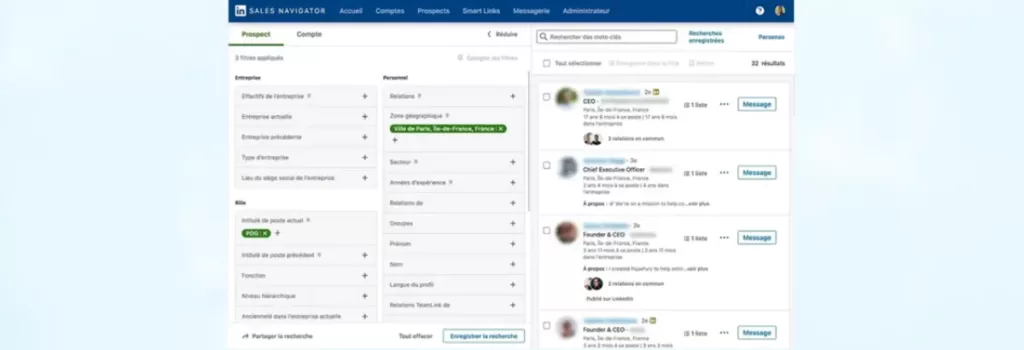
For those serious about knowing how to make LinkedIn work for your business, Sales Navigator is a non-negotiable tool. It allows you to build a targeted list of ideal prospects who are active and reachable.
Building the List
Do not search by job title alone. Job titles are often misleading. Search by function and seniority.
- Filter: Seniority Level (CXO, VP, Director)
- Filter: Company Headcount (Matches your ideal client profile)
- Filter: Posted on LinkedIn in the last 30 days.
This final filter is crucial. It ensures you are not wasting time messaging users who never log in.
The Boolean Search Strategy
Use Boolean logic to refine your search. This helps eliminate false positives in your search results.
- String: (SaaS OR Software) AND (Founder OR CEO) NOT (Agency OR Consultant).
This removes noise and delivers a clean list of prospects.
The Lead List Workflow
Save your ideal prospects to a Lead List. Check this list daily. When a lead posts content, engage with it. When a lead changes jobs, send a congratulatory message. This allows you to monitor your market without sending spam.
Part 7: What Is the Conversion Mechanism on LinkedIn?
When you execute the content and conversation layers correctly, conversion becomes a natural progression rather than a forced event.
The Belief Velocity Metric
Traditional metrics like open rates and likes are vanity metrics. The metric that matters is Belief Velocity. This measures how quickly a prospect moves from awareness to intent.
If your content is effective, prospects will enter your pipeline with a high level of education. They will ask advanced questions rather than basic ones. If you find yourself constantly explaining the basics on sales calls, your content is failing to educate.
The Asynchronous Close
By utilizing the Protocol Document and the Diagnostic Dialogue, you remove the need for high-pressure closing techniques. The sales call changes from a persuasion event to a fit-assessment event.
The Pre-Call Ritual
Before a scheduled call, send a confirmation message with an asset.
- Message: “Looking forward to our chat tomorrow. To save us time, I am attaching a brief overview of our framework. It might spark some specific questions for our call.”
This ensures the prospect arrives at the meeting prepared and respectful of your expertise.
The Voice Note Follow-Up
If a prospect goes silent after a meeting, avoid generic check-in emails. Send a voice note on LinkedIn.
- Message: “I was thinking about our conversation regarding compliance risks. I realized we did not cover how the new regulations impact your Q3 audit. I have a thought on that if you want to hear it.”
Voice notes convey tone and empathy which text cannot. They humanize the follow-up process and often re-engage stalled deals.
Part 8: What Is the Daily Execution Routine on LinkedIn?
Consistency is the primary driver of trust. You need a disciplined routine to execute this playbook without burnout. A focused sixty-minute block is sufficient.

00-15 Minutes: The Extraction
Go for a walk or sit in a quiet room. Record your daily insight based on client work or market observations. Transcribe it. Edit it into a post. Publish.
15-30 Minutes: The Engagement
Open your Sales Navigator Lead List. Comment on five posts from key decision-makers. Do not say “Great post.” Read what they wrote and add a specific insight or a counter-perspective. This leverages their audience to build your authority and triggers a notification that you are a peer.
30-60 Minutes: The Dialogue
Check who viewed your profile. If they fit your ideal client profile, send a low-pressure message acknowledging the visit. Reply to comments on your posts with questions to spark dialogue. Respond to active direct messages using the Diagnostic Dialogue framework. Send one resource drop to a warm prospect.
Part 9: Troubleshooting and Optimization on LinkedIn
Even with a perfect system, friction will occur. Here is how to handle common failure points.
Problem: No one comments on my content.
- Diagnosis: You are likely writing broad advice rather than specific insights.
- Fix: Narrow your focus. Instead of writing about leadership, write about the difficulty of firing a toxic high-performer. Specificity breeds engagement.
Problem: Prospects ghost after I send the price.
- Diagnosis: You did not build enough value before revealing the cost. Or, you revealed the cost without context.
- Fix: Ensure they have read the Protocol Document before discussing price. The document builds the value context that justifies the investment.
Problem: I get likes but no DMs.
- Diagnosis: Your content is entertaining but not authoritative. You are building an audience, not a client base.
- Fix: Shift your content mix. Publish more teardowns and case studies. These formats may get fewer likes, but they demonstrate the competence required to hire you.
Part 10: Sustainable Growth on LinkedIn
The era of extraction marketing is ending. Buyers are too sophisticated and tools are too automated. The future of B2B sales belongs to those who cultivate relationships through genuine expertise and low-friction engagement.
By building a system based on the mechanics of credibility, you create a business asset that appreciates in value. You stop chasing leads and start attracting clients who are pre-sold on your value.
To truly understand how to make LinkedIn work for your business, you must commit to the long game. Build infrastructure that supports trust. Create content that validates expertise. Engage in conversations that diagnose problems.
This is the path to sustainable revenue.
We at Hootbox Media Works use our strategic offering, LinkedIn Trust Builder to help you build this entire LinkedIn Marketing system and get you closer to your goals of getting seen, trusted and chosen. Talk to us.
FAQs
Is it necessary to have a large following to generate revenue on LinkedIn?
It is a common misconception that generating revenue on LinkedIn requires a massive following. Revenue is driven by the depth of connection with specific decision-makers, not the total width of the audience. A following of five hundred relevant buyers is infinitely more valuable than a following of fifty thousand random users. The goal is to build a targeted audience of potential clients and engage them deeply on their specific business problems. You can generate significant revenue with a small, engaged network if your content speaks directly to their expensive challenges, rather than trying to appeal to a broad, general audience.
How do I transition from a personal profile to a company page strategy?
When deciding between a personal profile and a company page strategy, data indicates that personal profiles currently receive significantly higher organic reach. This is because users on the platform prefer connecting with human experts rather than faceless corporate logos. The most effective strategy is a Hub and Spoke model. The founder and key leaders act as the Spokes, posting original insights and engaging in dialogue to drive growth. The Company Page acts as the Hub, serving as a repository for case studies, official updates, and employee content. Focus your energy on the personal profiles for growth and the company page for brand validation.
What if I am in a boring industry like manufacturing or logistics?
Professionals in technical sectors often worry that their industry is too boring for social media, but there are no boring industries, only boring content. In fact, niche technical industries like manufacturing or logistics often perform better on LinkedIn because there is less competition and higher demand for expertise. A manufacturing CEO sharing specific insights about supply chain resilience or raw material procurement will attract a highly qualified audience. Avoid general advice and lean into the technical complexity of your field, as your ideal clients value technical nuance over entertainment.
How much time does it take to see results from this trust-based approach?
Business leaders often ask how long it takes to see ROI from a trust-based LinkedIn strategy. This is a compounding strategy rather than a direct response tactic. You should expect to see qualitative signals such as deeper conversations and better profile views within the first thirty to sixty days. Quantitative results like revenue and closed deals typically begin to accelerate around the three to six-month mark. Unlike advertising, which stops generating leads when you stop paying, the reputation and authority you build through this system continue to pay dividends long-term.
Should I accept connection requests from people I do not know?
The question of whether to accept connection requests from strangers depends on the relevance of the individual. Since LinkedIn is a networking tool, connecting with strangers is the primary function, provided they are relevant to your industry or are potential buyers. You should review their profile to ensure they look like a real person active in your sector. If they fit your ideal client profile or work in a related field, accept the request to increase the surface area for your content. If they appear to be a bot or a generic lead generation account, ignore the request to maintain network quality.
How do I deal with negative comments or trolls on my posts?
Handling negative comments or disagreement is a concern for many B2B brands, but true trolling is rare in professional contexts. Disagreement, however, is common and valuable. If someone disagrees with your perspective respectfully, you should engage with them, as a healthy debate demonstrates your confidence and depth of expertise to the wider audience. If a comment is purely toxic or promotional spam, delete it and block the user immediately to protect the culture of your comment section and ensure your actual prospects feel safe engaging there.
Can I delegate my LinkedIn activity to a virtual assistant or agency?
Delegating LinkedIn activity to a virtual assistant is not a problem but you cannot leave it completely to them. While you can delegate the logistics, such as scheduling posts, cleaning up the CRM, and accepting connection requests, you cannot delegate the voice. An assistant should not write your strategic posts or reply to your direct messages, as the nuance and expertise required to build trust must come directly from you. If the audience senses a ghostwriter or a bot, your credibility is destroyed instantly, undermining the entire trust-building effort. At Hootbox Media Works, we have a strategic offering ‘LinkedIn Trust Builder‘ with which we entirly handle your LinkedIn marketing from writing to distribution and everything in between but we ensure that your every communication carries your voice. To enable this, we spend 10 hours per month with you to get your stories, tonality, opinions right.
Is Sales Navigator worth the investment for this strategy?
Many users question if the premium cost of LinkedIn Sales Navigator is justified. For a targeted revenue strategy, Sales Navigator is an essential tool because it allows you to build a precise list of prospects based on specific criteria such as headcount, revenue, and recent activity. This ensures that your engagement time is spent only on high-probability targets. Using the standard free search often leads to inaccurate results and wasted effort, making Sales Navigator a non-negotiable investment for serious business development.
How do I balance selling with providing value in my content?
Balancing sales messaging with value creation is often viewed as a trade-off, but this is a false dichotomy. Good selling is providing value. If you share a case study that shows a client how to solve a specific problem, you are selling your expertise while simultaneously providing educational value to the reader. The rule of thumb is to sell the problem, not the product. Spend 80 percent of your content articulating the problem and the cost of inaction. When the prospect understands the problem deeply, the sale of the solution becomes a natural next step.
What is the biggest mistake companies make when starting on LinkedIn?
The most significant error companies make when launching a LinkedIn strategy is inconsistency followed by impatience. Many companies post daily for two weeks, see no immediate leads, and stop, or they post sporadically and expect momentum. Trust requires frequency and reliability. It is far more effective to post twice a week for a year than daily for a month. The LinkedIn algorithm and the professional audience reward those who show up consistently over long periods, making endurance the key to success.