Key takeaway: Most B2B SMEs believe they have a lead generation problem, so they keep buying more marketing. In reality they have a lead operations problem. The pipeline is built. What is missing is a single named owner for the last mile, the stretch between a lead arriving and a deal closing. That gap is the real reason B2B leads don't convert. Fix ownership before you fix budget.
“Har ghar nal ka jal”.
Water to every home.
On paper, one of the most ambitious last-mile promises this country has ever made.
Last week a CAG audit pulled the cover off part of it. In Bihar, it found that even where water treatment plants had been built, many were simply not running. The pipes were laid. The taps were installed. On every dashboard the scheme read "delivered." And yet in a lot of homes, the tap was dry.
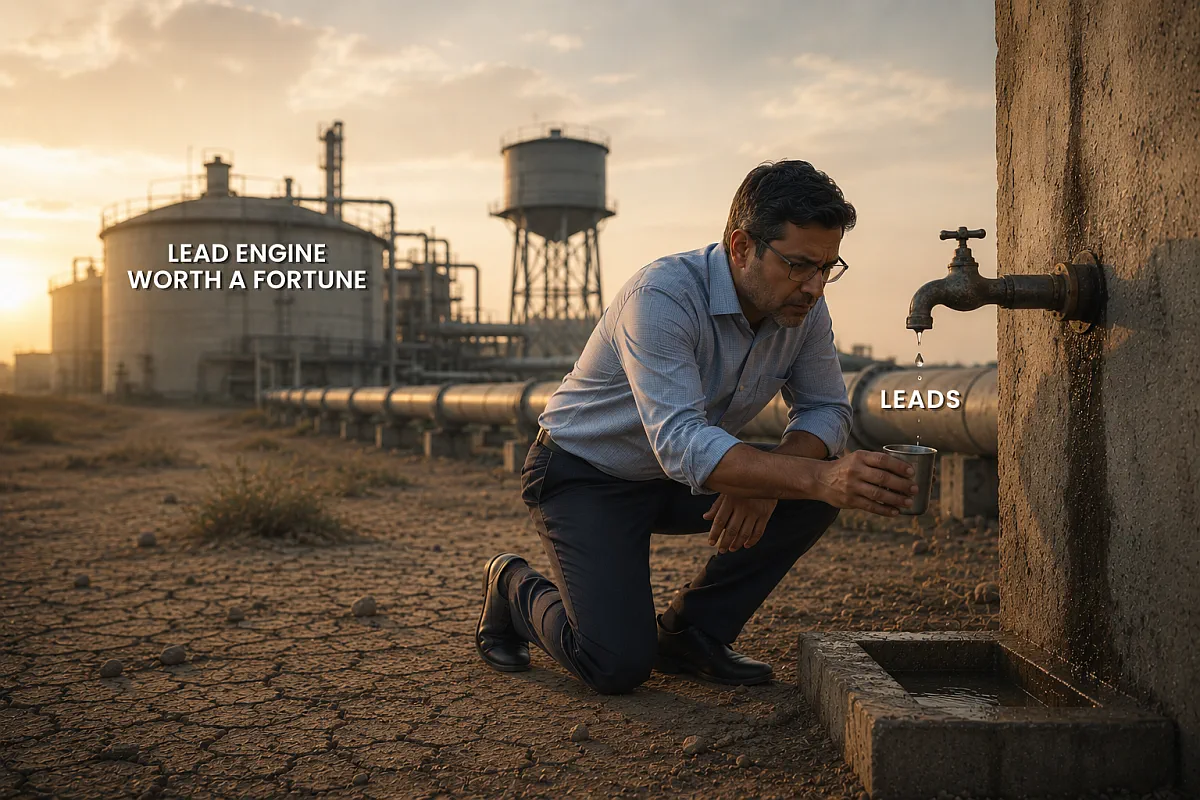
Pause there, because if you run a B2B company, you have almost certainly built the same thing inside your own business. You just call it your lead engine.
Your lead engine is built. So why is the tap dry?
Here is what most B2B SME founders have already done, and done well.
You built the website. You put money into Google and LinkedIn ads. You bought the CRM. You hired an agency, or a marketing person, or both. You exhibit at the trade show. You have a product catalogue, a contact form, an enquiry number. Someone drew you a funnel once and it made sense.
That is the treatment plant. That is the pipe. That is the tap on the wall.
And like every ribbon-cutting, it photographs well. You can point to it. You paid real money for it. On the dashboard the project reads "done."
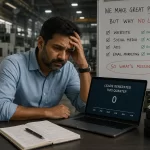
Then you look at the one number you cannot fake in a review meeting: how many enquiries actually turned into orders this quarter. And the honest answer, too often, is less than they should have. The pipes are there. The water is a trickle.
We are trained to read this as an infrastructure problem. More budget. A new website. Another tool. A different agency. So we build a second plant next to the first one that also does not run. That is the trap: treating a dry tap as proof that you need more pipe.
In B2B, it is almost never a pipe problem. It is an operations problem. Nobody owns running the thing after it was switched on.
Is B2B lead generation a marketing problem or a sales problem?
Neither, and that is exactly why it breaks.
B2B is not retail. A buyer does not see an ad and check out ten minutes later. In B2B the purchase is considered, the ticket is high, the cycle runs weeks or months, and three to seven people influence the decision before you ever hear "send us a quote." The value is not created at the click. It is created across the long, patient last mile between first enquiry and signed order.
That last mile falls into the gap between two departments who each think their part is done.
Marketing believes the job ends when the lead is generated. "We delivered the enquiries."
Sales believes the job is to close the ones that are ready, and the rest were bad leads. "Marketing sent us junk."
The founder assumes the agency handles it.
The agency assumes the founder's team handles it.
The CRM assumes a human is driving it.
And the enquiry, an actual business that raised its hand and said it might buy from you, sits unopened for two days and then contacts your competitor.
In B2B that delay is fatal in a way it simply is not in B2C. When a procurement manager sends the same RFQ to four suppliers, the order very often goes to whoever responds first and follows through, not whoever had the best ad. Speed and follow-up are not marketing polish. In B2B they are the product.
What “last-mile ownership” actually means in B2B
Between "a lead arrives" and "we win the business," a series of operational decisions determines whether an opportunity becomes revenue or slips away.
The enquiry needs to be acknowledged while buyer intent is still fresh. It must be qualified to establish whether the prospect is genuine, the right fit and worth pursuing. From there, it should reach the appropriate salesperson or channel partner without unnecessary delays, followed by a disciplined sequence of follow-ups because very few B2B deals are won through a single conversation.
Along the way, the CRM needs to remain accurate so every interaction happens when it should, rather than depending on memory or an outdated spreadsheet. The process also requires someone to continually review where high-quality enquiries are coming from, separating genuine buying intent from noise and redirecting marketing investment towards the channels that consistently produce business.
This entire journey is the last mile. It is the stretch between generating demand and converting it into revenue, and it is precisely where most B2B SMEs experience the greatest leakage. The issue is rarely a lack of effort; it is the absence of clear ownership. When no one is accountable for moving an enquiry through the pipeline, opportunities simply fade away.
This is an uncomfortable reality. A founder will cheerfully approve another fifty thousand rupees of ad spend to generate more enquiries, while the enquiries they already paid for on Monday sit unanswered on Wednesday. We lay more pipe while the water we already have runs into the ground.
If that stung a little …. good. That sting is the actual problem, and it does not have a hardware fix.
Who should own lead follow-up in a small B2B company?
In the water scheme the failure was not engineering. India can build a treatment plant. The failure was operations and maintenance. Once the cameras left, who was accountable for the plant running daily, for the pump that broke, for the leak nobody fixed? When the answer is "everyone, therefore no one," the tap runs dry no matter how good the construction was.
Your lead engine dies the same death, and the fix is unglamorous, which is precisely why it gets skipped.
Someone, a named person, not a department, has to own the last mile end to end. One needs to own the:
- Response time, so no enquiry ages past a few hours.
- Follow-up cadence, so lead number ten gets the same discipline as lead number one.
- Definition of a qualified lead, agreed between marketing and sales in advance instead of argued about after the fact. This is the MQL-to-SQL handoff, and in most SMEs it is a cliff, not a bridge.
- Weekly review of what is actually converting, with the authority to move money towards it.
Ownership means a name and a number, not a tool and hope. That owner can be a person you hire, a discipline you install, or a partner you bring in, but the accountability has to sit somewhere specific. This is the layer we spend most of our time building for founders at Hootbox, and it is almost never "you need more marketing." It is "the last mile has no owner."
The water in the tap is the only thing that counts
The scheme was never really about pipes. It was about water in the home. Everything upstream is just means to that one end.
Your marketing was never really about the website, the ads, or the CRM. It was about revenue. Everything else is just pipe.
So before you approve the next tool, the next agency, the next tranche of spend, ask the cheaper question first. Not "what more can we build?" but "who owns making what we already built actually run?"
Har ghar nal ka jal … par ayega kal.
The water will reach every home …. But only tomorrow.
In your business, "kal" arrives the day someone finally owns the last mile. Until then, you do not have an infrastructure problem.
You have a dry tap and very expensive pipe.
FAQs
Why don’t my B2B leads convert even though I generate enough of them?
Usually because no one owns the last mile between enquiry and order. Leads are generated but not responded to quickly, not qualified consistently, and not followed up enough times. In B2B, where deals need multiple touches over weeks, that operational gap loses more revenue than any shortfall in lead volume.
B2B lead generation a marketing problem or a sales problem?
It is an operations problem that lives between them. Marketing owns generating leads, sales owns closing ready ones, and the critical middle, fast response, qualification, routing and persistent follow-up, ends up owned by no one. That handoff gap is where most B2B pipelines leak.
What is last-mile ownership in lead management?
It is a single named person being accountable for everything that happens after a lead arrives: response speed, qualification, follow-up cadence, CRM hygiene, and reallocating spend to what converts. Not a department, not a tool. A name and a number.
How fast should you respond to a B2B inbound enquiry?
As fast as operationally possible, ideally within minutes and no later than the same working day. When a buyer sends the same RFQ to several suppliers, the first credible responder often wins the order regardless of who ran the better campaign.
What is the difference between an MQL and an SQL, and why does it matter for SMEs?
A Marketing Qualified Lead has shown interest; a Sales Qualified Lead has been vetted as a genuine, ready buyer. In most SMEs the definition of u0022qualifiedu0022 is never agreed between the two teams, so leads fall through the handoff. Agreeing that definition upfront is one of the cheapest, highest-return fixes available.
Should a small B2B company hire for this or outsource it?
Either works. What matters is that the accountability is explicit and sits with someone who has the time and mandate to run it daily. The failure mode is leaving it as everyone's job, which reliably makes it no one's.