B2B selling sometimes feels hard in the consideration stage of a buyer’s journey because buyers lack confidence. They are not sure whether a specific approach will work in their reality, whether the risk is worth it, and whether they can justify the choice to others inside the company. Even strong data and feature lists don’t solve that hesitation on their own because buyers still need a clear narrative that connects the dots and makes the decision feel safe. That is what these story marketing frameworks are built to deliver.
How do you get the skeptical brain of a buyer to say 'Yes'?
This is a fundamental challenge faced by all - be it a robotics team pitching in a glass-walled boardroom in Tokyo, an L&D founder navigating a skeptical agency in London, or a safety vendor shouting over the din of a manufacturing plant in Mumbai.
For decades, the answer was "Data." Show them the charts. Show them the specs. But as we move into 2026, data has become a commodity. Everyone has data. Everyone has "best-in-class" features.
The only differentiator left is the Narrative.
“Storytelling” in B2B is often misunderstood. Fairy tales and flowery language aren’t the point. Structure is. A message built with structure slips cleanly into the buyer’s brain.
At Hootbox Media Works, we believe in story marketing frameworks. A framework turns storytelling from an "Art" (which is hard) into a "Process" (which is scalable).
In this guide, we are going to look at 5 World-Class Story Marketing Frameworks from Silicon Valley to Harvar and show you how to apply them to your B2B business today.
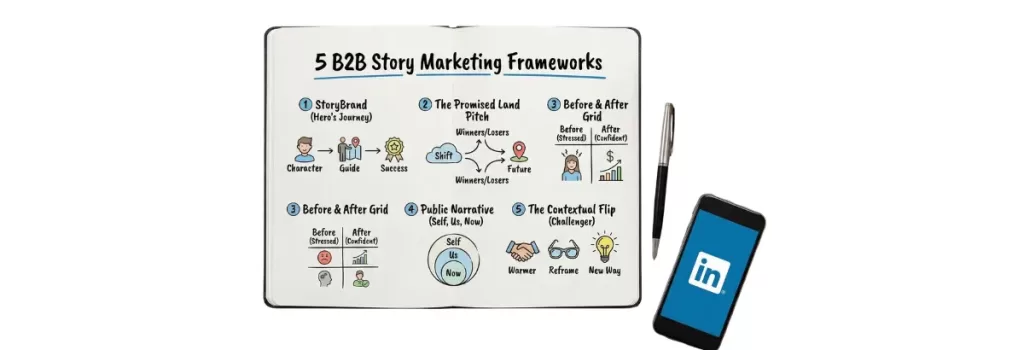
Story Marketing Framework #1: The “StoryBrand” Framework (The Hero’s Journey)
Origin: Donald Miller
This is the gold standard for clarity. If your website is confusing, start here.
The Philosophy: Most companies waste money trying to be the Hero (Luke Skywalker). They should be the Guide (Yoda).
The 7-Step Structure:
- A Character: Your Customer (The Hero).
- Has a Problem: The Villain (e.g., Inefficiency, Risk, Waste).
- And Meets a Guide: You (The Expert with Empathy).
- Who Gives Them a Plan: A simple 3-step process.
- And Calls Them to Action: The "Buy Now" button.
- That Helps Them Avoid Failure: What happens if they don't buy? (Tragedy).
- And Ends in Success: The Happy Ending.
Global Application (L&D Example):
- Character: An L&D founder in Bengaluru pitching a workforce upskilling program to a large enterprise.
- Problem: The “Skepticism Wall” (Villain). The buyer fears low adoption and no measurable impact, so budget approvals stall.
- Guide: The L&D firm as the guide. “This rollout has improved completion and on-the-job behavior across similar teams.”
- Plan: Diagnose learner context → Deliver microlearning in the flow of work → Track behavior + business metrics.
- Success: The buyer gets a clean impact story for the CFO and CEO, and the program gets approved without endless back-and-forth.
Actionable: Audit your website’s homepage and other messaging today. If the word "We" appears more than "You," rewrite it using this framework.
Story Marketing Framework #2: “The Promised Land” Pitch
Origin: Andy Raskin (Silicon Valley's Top Narrative Strategist)
This framework is best for Disruption and Category Creation. If you are selling something new that people don't understand yet, use this.
The Philosophy: Don't sell the product. Sell the Shift in the World.
The 5-Step Structure:
- The Undeniable Shift: Start with a change in the world that creates urgency. (e.g., "AI is eating software.")
- The Winners & Losers: Show that this shift creates two groups. Those who adapt (Winners) and those who don't (Losers).
- The Promised Land: Describe the future where the customer has won. (Not your product, but their life with your product).
- The Magic Gifts: Introduce your features as "weapons" to reach that land.
- Evidence: Show that others have already reached the Promised Land with you.
Global Application (Cybersecurity Example):
- Shift: "Hackers are now using AI to crack passwords." (Undeniable).
- Winners/Losers: "Companies with static defense will fall. Companies with adaptive defense will survive."
- Promised Land: "A world where you never fear a data breach."
- Magic Gift: Your AI-Defense Software.
Actionable: Use this for your Sales Deck. Slide 1 should never be "About Us." Slide 1 should be "The World Has Changed."
Story Marketing Framework #3: The "Before & After" Grid
Origin: Ryan Deiss (DigitalMarketer)
This framework is perfect for Copywriting - ads, emails, and landing pages. It forces you to focus on the Transformation.
The Philosophy: People don't buy products; they buy a better version of themselves.
The Grid: Ask these questions about your client:
- Have: What do they have before vs. after? (e.g., "Manual Spreadsheets" vs. "Automated Dashboard").
- Feel: How do they feel? (e.g., "Anxious/Overwhelmed" vs. "Confident/Relieved").
- Average Day: What is their day like? (e.g., "Staying late to fix errors" vs. "Leaving at 5 PM").
- Status: How are they perceived? (e.g., "The Bottleneck" vs. "The Innovator").
Global Application (Logistics Example):
- Before: The Logistics Manager Feels stressed. His Average Day is fighting fires. His Status is "The guy who delays shipments."
- After: He Feels in control. His Average Day is strategic planning. His Status is "The guy who saved the company 10%."
Actionable: Run this grid with the sales team. If they can’t describe the buyer’s “After” in plain words, the pitch will stay feature-heavy and price-sensitive.
Story Marketing Framework #4: Self, Us, Now - “Public Narrative”
Origin: Marshall Ganz (Harvard Kennedy School)
This framework is powerful for Leadership Communication and Mission-Driven Brands.
The Philosophy: To move people to action, you must connect your personal values to their values, and then to the urgent moment.
The 3-Step Structure:
- Story of Self: Why do you care? (Your personal origin story).
- Story of Us: Why do we (the community/company) care? (Shared values).
- Story of Now: Why must we act today? (Urgency).
Global Application (Green Solutions / ESG Example):
- Self: "I grew up near a polluted river. I saw the damage firsthand." (Founder's story).
- Us: "We, as an industry, have a responsibility to clean up our supply chain." (Shared value).
- Now: "Regulations are changing in 2026. If we don't act now, we become obsolete." (Call to action).
Actionable: Build a 90-second “Self–Us–Now” story and use it as the opening of every investor pitch, partner meeting, and enterprise sales call to align the room before numbers start.
Story Marketing Framework #5: “The Challenger Sale”
Origin: Brent Adamson & Matthew Dixon
This is best for Complex B2B Sales where the client thinks they know everything.
The Philosophy: Don't just ask the client what they want. Tell them what they are missing.
The Structure:
- The Warmer: Build credibility. "We see this problem in companies like yours."
- The Reframe: Introduce a new perspective. "You think the problem is X, but actually, it's Y."
- Rational Drowning: Show the data that proves why Y is scary.
- Emotional Impact: Show how Y hurts them personally.
- A New Way: Show the solution (which only you can provide).
Global Application (Consulting Example):
- Warmer: "We know you are trying to cut costs."
- Reframe: "But cutting costs on training is actually increasing your error rate by 20%."
- Drowning: Show the graph of Error Rates vs. Training Cuts.
- Impact: "This error rate is why you missed your Q3 targets."
- New Way: "Our Training-as-a-Service model fixes this."
Actionable: Use this when a client says, "We are happy with our current vendor." You need to break their status quo.
Which Framework Should You Choose?
- For your Website: Use StoryBrand. (Clarity is King).
- For your Pitch Deck: Use The Promised Land. (Vision sells).
- For your Ads: Use Before & After. (Transformation sells).
- For your Mission: Use Public Narrative. (Emotion connects).
- For Tough Sales: Use The Contextual Flip. (Insight disrupts).
At Hootbox Media Works, we don't just guess. We pick the right tool for the job. The global market is noisy. The only way to cut through is to stop improvising and start engineering your story.
Ready to build your narrative engine? Let’s pick a story marketing framework and get to work.
Start a conversationHootbox Media Works
Great Story Marketing for Great B2B SMEs
FAQs
1. Will a story marketing framework make a complex B2B product sound too simple or less expert?
Using a story marketing framework for technical products does not dilute expertise; in fact, it is essential for organizing complexity. When technical founders bombard buyers with raw data, it creates cognitive load. Frameworks like StoryBrand clarify why those technical specs matter to the buyer's bottom line. By using a framework, you aren't simplifying the solution; you are simplifying the buyer’s path to understanding that solution.
2. Are story marketing frameworks effective for B2B industries, or are they better suited for B2C companies where buyers are driven by emotion?
While B2B buyers certainly justify decisions with logic (data, ROI, compliance), the initial decision to engage is almost always rooted in confidence, which is an emotional driver. Frameworks like The Contextual Flip are designed specifically for this B2B dynamic. They use narrative to build trust and challenge assumptions first, so that the buyer is actually listening when you finally present the logical data. Without the story, the data has no context.
3. How can a B2B leader measure the concrete ROI of implementing a story marketing strategy?
The ROI of a story marketing framework is best measured by tracking sales velocity and conversion rates rather than just "brand awareness." A clear narrative removes the confusion that often stalls B2B deals. Companies utilizing frameworks like The Promised Land typically see a reduction in the length of their sales cycles because the story aligns stakeholders faster, reducing the back-and-forth friction that kills deals in the consideration stage.
4. For a B2B SME with a small marketing team, which story marketing framework is the easiest to implement immediately without a large budget?
For teams with limited resources, The Before & After Grid is the most immediate, low-barrier framework to implement because it requires no design or coding changes. A founder or sales lead can simply sit down for 30 minutes, map out the customer’s "Before" state (stress, inefficiency) versus their "After" state (relief, growth), and immediately use those insights to sharpen cold emails and sales calls without needing a full website overhaul.
5. Is it effective to mix different story marketing frameworks (like StoryBrand and Challenger Sale), or should a company strictly stick to just one methodology?
B2B companies should absolutely mix different story frameworks because they serve different stages of the buyer's journey. For example, a business might use the StoryBrand framework on their website to ensure immediate clarity for new visitors, while simultaneously using The Contextual Flip in the sales deck to challenge deeply held beliefs during high-stakes client meetings. The frameworks are tools in a toolkit, not mutually exclusive religions.
6. If every B2B company starts using standard story frameworks like the "Hero's Journey," won't all brands start sounding the same?
Adopting a popular structure like the Hero’s Journey will not make a brand sound generic because the framework is merely the skeleton, not the meat. While the structure of the message may follow a proven pattern (Problem → Solution → Success), the content, your specific customer examples, your unique methodology, and your brand voice, remains yours alone. It is similar to how all successful movies follow a 3-act structure but tell wildly different stories.
7. Does adopting a story marketing strategy require a B2B company to scrap its existing website and marketing materials completely?
Implementing story marketing does not require a "rip and replace" of all existing assets; it is more effective to prioritize high-impact touchpoints. B2B leaders should start by refining the Homepage headline and the primary Sales Pitch Deck using a framework. Once those critical assets are converting better, the team can gradually update case studies, whitepapers, and email sequences to align with the new narrative over time.
8. Can story marketing frameworks work effectively in traditional or "dry" industries like manufacturing, logistics, or compliance?
Story marketing frameworks are often more effective in traditional or "dry" industries than in creative ones because the contrast is sharper. In sectors like manufacturing or logistics, most competitors are likely still shouting feature lists and technical specs. By using a Public Narrative or Promised Land pitch in these spaces, a company immediately differentiates itself as a visionary partner, standing out vividly against a sea of "commodity" competitors.
9. How can leadership get a B2B sales team to adopt story marketing when they are used to selling features and pricing?
The best way to get sales teams to adopt story frameworks is to present them as "sales enablement tools" rather than "storytelling scripts." When you give a salesperson a tool like the Before & After Grid, it provides them with specific language to describe the client's pain points. Once sales teams realize that this narrative-based language helps them handle objections better and close deals faster, adoption usually follows naturally.
10. Why should a company hire an external consultant for story marketing strategy rather than just reading the books and doing it in-house?
While internal teams can understand the theory of these frameworks, hiring an external consultant is often necessary to overcome "The Curse of Knowledge." Founders and internal teams are deeply immersed in their own product details and often struggle to see the business from the customer's fresh perspective. An external partner acts as an objective filter, helping to identify the simple, high-level story that actually converts, which is difficult to see when you are "inside the bottle."
11. What exactly is "B2B Story Marketing," and how is it different from just writing good copy?
B2B Story Marketing is not just about writing catchy headlines; it is a strategic discipline that uses narrative structures (like the Hero's Journey) to organize information. While standard copywriting focuses on describing features and benefits, B2B Story Marketing focuses on positioning the customer as the protagonist who overcomes a specific challenge using your product. It turns your marketing from a list of specs into a coherent journey that the buyer wants to join
11. What exactly is "B2B Story Marketing," and how is it different from just writing good copy?
B2B Story Marketing is not just about writing catchy headlines; it is a strategic discipline that uses narrative structures (like the Hero's Journey) to organize information. While standard copywriting focuses on describing features and benefits, B2B Story Marketing focuses on positioning the customer as the protagonist who overcomes a specific challenge using your product. It turns your marketing from a list of specs into a coherent journey that the buyer wants to join
13. What all story marketing frameworks are available?
Effective B2B story marketing relies on a mix of classic narrative structures and sales-specific models. The most widely cited framework is StoryBrand (or the Hero’s Journey), which positions the customer as the "hero" and your brand as the "guide." Other key frameworks include Problem-Agitate-Solve (PAS) for highlighting pain points, the Before & After method for showing transformation, and narrative structures like the Three-Act Structure, Freytag’s Pyramid, and the Pixar Framework to build emotional engagement. For simpler, clearer communication, marketers also use the Golden Circle (Why-How-What) and CAR (Content, Action, Results).